


Immediate action required: Call 999 if you're experiencing any of the following:
- your reliever inhaler is not helping or is not lasting four hours at a time
- you’re finding it difficult to walk or talk because you’re breathless
- you’re finding it difficult to breathe
- you’re wheezing a lot, have a very tight chest, or are coughing a lot.
These are signs of an asthma attack.
Even if your peak flow is normal, having signs of an asthma attack is always an emergency.
Follow your asthma action plan if you have one.
What is peak flow?
Peak flow is a measure of how quickly you can blow air out of your lungs. If you have asthma, your airways can sometimes become inflamed or narrowed. This can make it more difficult to blow the air out of your lungs quickly and can change your peak flow score.
You measure peak flow using a small hand-held device called a peak flow meter. See our instructions for using a peak flow meter, including a video explanation.
Your peak flow score is also called your peak expiratory flow (PEF).
When is peak flow used?
Peak flow is both used to diagnose asthma and to help monitor it. The information on this page is mainly about helping you understand how to use peak flow to help monitor your asthma.
Peak flow to help diagnose asthma
If you’re having symptoms that could be asthma, your GP may ask you to keep a peak flow diary for two or more weeks to help them make a diagnosis. The GP will compare your pattern of peak flow scores to what’s expected for your age, height and sex.
If there’s a big difference between your score and the expected score, or your score when you have symptoms or not, it could suggest you have asthma.
Your GP will consider your general health and the results of other tests, like spirometry and FeNO, along with your peak flow scores to help decide whether you may have asthma.
Peak flow to monitor asthma
Some people find that peak flow monitoring helps them to notice early signs that their asthma may be getting worse.
Healthcare professionals do not always recommend peak flow monitoring for asthma. This is because for some people, understanding how their asthma symptoms change is the best way to manage their asthma well, rather than focusing on peak flow scores.
The most important thing is to monitor your asthma in a way that works well for you. You could use our symptom diary to record your day-to-day symptoms. Understanding your usual symptoms could help you to notice any patterns or changes in your symptoms that may lead to an asthma attack.
Talk to your GP or asthma nurse about whether monitoring your peak flow would be helpful for you. They should explain how often to check it, and what to do when your scores change. Make sure this is written in your asthma action plan.
Your healthcare professional may also do a peak flow test at your annual asthma review.
There are times when you might be asked to check your peak flow at home. This means taking your peak flow every day and writing down your scores in a peak flow diary.
Checking your peak flow at home is most useful if you’re recovering from an asthma attack, your treatment plan has changed, or your symptoms are difficult to control.
Always use an asthma action plan alongside your peak flow diary
Asthma action plans help you manage your asthma well and explain what to do if your symptoms get worse. There’s space on the plan for you to write down actions you and your healthcare professional have agreed if your symptoms change or your peak flow score is lower than usual.
Find out more about asthma action plans.
How to use a peak flow meter
When you first get a peak flow meter, ask your GP, asthma nurse or pharmacist to show you how to use it and how to take a reading.
Take these steps to make sure you use your peak flow meter correctly:
- Pull the counter (the red arrow) back to where the numbers start. The counter is sometimes called a pointer.
- Stand or sit upright – choose what’s most comfortable for you and always do it that way.
- Take the deepest breath in you can.
- Make sure your mouth makes a tight seal around the mouthpiece.
- Blow as hard and fast as you possibly can into the meter.
- Write down your score – this is the number next to the pointer.
- Do steps 1 to 6 three times in a row, with a short rest in between, so you get three scores. All three scores should be roughly the same.
- Use the highest of these scores to fill in your peak flow diary.
As well as the pointer that shows your peak flow score, some peak flow meters may have more coloured markers on the side. These may be red, amber, and green. Ask your healthcare professional to set these to show your best and worse peak flow scores. This can help you quickly see what your current score means and if you need to take any action from your asthma action plan.

How to use a peak flow meter
Hi I'm Naomi. I'm a respiratory nurse specialist at Asthma + Lung UK. I'm going to tell you how to use a peak flow meter.
When you first get a peak flow meter, ask your GP, asthma nurse or pharmacist to show you how to use it and how to take a reading.
If you're checking your peak flow at home, you need to take your peak flow at least twice a day, every day to get a useful pattern of results. Try to check it at the same time every morning and every evening.
You need to use your best effort every time you blow into the meter so you're comparing like with like and you should use the same peak flow meter every time.
Take these steps to make sure you use your peak flow meter correctly.
1. Pull the counter, the red arrow, back as far as it will go, to the top, near the mouthpiece. [Make sure the counter is where the numbers start].
2. Stand or sit upright. Choose what's most comfortable for you and always do it that way.
3. Then take the deepest breath you can and make sure your mouth makes a tight seal around the mouthpiece.
4. Then blow as hard and as fast as you possibly can into the meter, like this [demonstration of blowing into a peak flow meter by the person in the video].
5. Write down your score which is the number next to the pointer.
6. Do this three times in a row with a short rest in between so that you get three scores. All three readings should be roughly the same but don't worry too much if they vary.
7. Use the highest of these scores to fill in your peak flow diary.
If you have any questions about using your peak flow meter speak to your doctor, nurse or pharmacist. You can also call our helpline [on 0300 222 5800].
How can I get the best results from my peak flow meter?
If you want to monitor your asthma using peak flow, you’ll get the most useful results if you:
- ask your healthcare professional how often and for how long to take your peak flow readings. They may ask you to check your peak flow regularly, for example twice a day for a period of time.
- check your peak flow at the same time every morning and every evening – this is because scores can slightly vary at different times of the day.
- use your best effort every time you blow into the meter so you’re comparing like with like.
- take three readings and use your highest score to fill in your peak flow diary.
- use the same peak flow meter every time. If you start using a different peak flow meter, your scores may be slightly different. It’s important to discuss this with your healthcare professional.
- clean and replace your peak flow meter regularly. This is because peak flow meters can become less accurate over time and with frequent use. The information leaflet that comes with your peak flow meter will tell you the best way to clean it and how often you need to replace it.
- always use an asthma action plan alongside your peak flow diary so you know what to do if your symptoms get worse.
- write down your symptoms and what you’ve been doing that day too, for example if you did exercise or if the pollution forecast was high. There’s space for you to do this in your peak flow diary. This helps you and your healthcare professional understand how patterns or different triggers affect your asthma.
- take your peak flow diary to your asthma review and any other asthma appointments to show your GP, asthma nurse or consultant how your asthma has been.
Understanding your peak flow scores
If you’re using peak flow to help monitor your asthma, the main thing is knowing the score that’s normal for you, sometimes called your personal best score. This can help you notice if your peak flow score drops lower than usual.


Your symptoms and how you feel are just as important as your peak flow score.
It’s important to always take action if you’re getting symptoms, even if your peak flow is normal.
Keep a peak flow diary
To understand your own peak flow, you need to see how your scores change over time. This means it’s important to note down your scores every day for as long as your healthcare professional has asked you to.
You can do this using a peak flow diary. Or you might want to note your scores on your phone using the calendar or a peak flow diary app. Many peak flow meters come with a peak flow calendar to note your scores.
You and your GP or asthma nurse can then look at the scores you’ve been getting and work out what score to expect when you’re well. Your asthma action plan can help you manage your asthma and recognise when your symptoms are getting worse.
Your best score
The score that’s usual for you when you’re well is sometimes called your ‘best score’.
If you’re using your medicines as prescribed and following your asthma action plan, you should stay close to your personal best score most of the time.
If you’ve recently changed your treatment plan and your peak flow score improves, this may help show you that your treatment is working well.
You need to record your peak flow for at least two weeks to find your personal best score. Ask your GP to check it again if it was last checked a few years ago, or if you change your peak flow device.
Lower than your best score
Talk to your GP or asthma nurse about what low scores you need to look out for, and what action you need to take. Write this down in your asthma action plan.
If you get a peak flow score that’s lower than your best score, this may be an early sign of an asthma attack or flare-up.
Getting a lower peak flow score can also help you find out what triggers could be making your asthma worse. For example, you might notice lower peak flow readings when pollen’s high, you’ve got a cold, or when you’re at work.
How much daily change is normal?
The scores you get, and any changes from them, are personal to you. Your GP or asthma nurse will help you understand what changes in your peak flow score you need to look out for and what to do if your scores change.
Make sure this is written in your asthma action plan.
It’s normal to see slight differences in your peak flow score, either between morning and evening scores, or from one day to the next. For example, people often have a lower score in the morning.
What if I get a much higher or lower score than usual?
You may sometimes get a peak flow score that’s much higher or lower than usual. A sudden drop in your peak flow score can be a sign that your asthma is getting worse, especially if your symptoms are getting worse too.
There can be other reasons you get a much higher or lower score, for example:
- how you’re using your peak flow meter – follow our steps on how to use your peak flow meter in the best way
- your peak flow meter may need cleaning or replacing – check the information leaflet that comes with your device.
- if you used a different peak flow meter than usual. Sometimes, a healthcare professional may also take your reading on a different peak flow device. Remember to set a new personal best reading with your healthcare professional if you get a new meter.
Follow our advice above to make sure you get the most accurate results.
Always check with your GP, asthma nurse or pharmacist if you have any questions.
Urgent advice: Ask for an urgent GP appointment or call 111 if you're experiencing any of the following:
- asthma symptoms like wheeze, a tight chest, feeling breathless, a cough
- waking up at night with asthma symptoms
- symptoms that stop you from doing your usual daily activities like work or physical activity
- needing your reliever inhaler much more often than usual.
Even if your peak flow is normal, it’s important to see a healthcare professional if your asthma is not well controlled or your symptoms are getting worse. They can help you manage your symptoms better.
Graph showing normal peak flow values
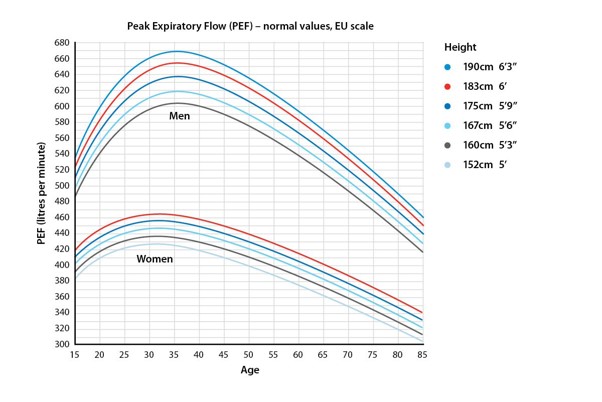
This graph shows the peak flow scores of people without a lung condition.
It shows that peak flow scores are usually expected to get lower with age. This is because it’s natural to have a gradual decrease in how well your lungs work as you get older. Your healthcare professional will help you understand your peak flow results and what they mean for you.
Where can I get a peak flow meter?
You can get a peak flow meter on prescription from your GP or asthma nurse. If you pay for your prescriptions, you’ll need to pay the usual cost for one peak flow meter.
You can also buy a peak flow meter yourself from a pharmacy or online.
If you’re buying one for a child, make sure it has a smaller mouthpiece and a lower scale.
How we develop our health information

About our health information
All our information is reviewed and updated by Asthma + Lung UK’s experienced Health Advice Team. People living with lung conditions, qualified healthcare professionals and specialists also review our content.
Our information is based on the latest, trustworthy evidence and guidelines. Below is a sample list of the sources referenced in our information about how emotions can affect asthma and other lung conditions.
- BTS, NICE, SIGN, Guidance NG245, Asthma: diagnosis, monitoring and chronic asthma management, Accessed: June 2026
- GINA (Global Initiative for Asthma), 2025 GINA Strategy Report - Global Strategy for Asthma Management and Prevention, Accessed: June 2026
- NHS, Health A-Z, Peak flow test, Accessed: June 2026
- Patient, Peak flow meter for asthma, Accessed: June 2026
If you'd like a full list of the sources we've used to produce our health information, you can email us at healthadvicequeries@asthmaandlung.org.uk.

Get support
Call or email our helpline for support with any aspect of living with asthma – whether you need practical advice, emotional support, or answers to health-related questions. You can also find support through our groups.